
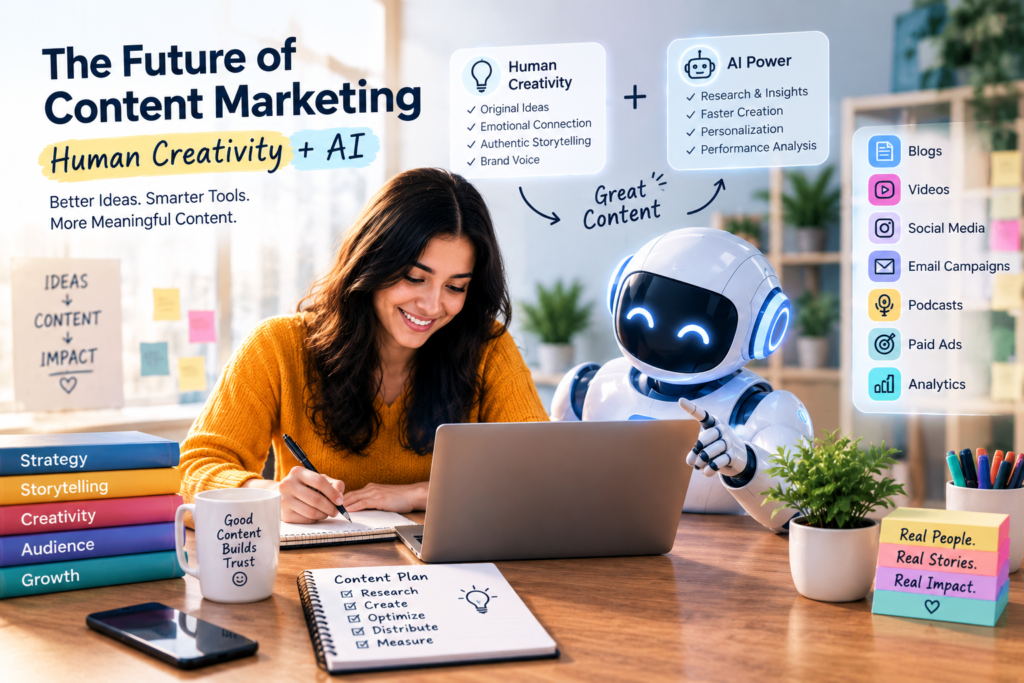
Content marketing is changing faster than ever. Artificial intelligence (AI) is transforming how businesses research topics, create content, analyze audiences, and distribute campaigns. At the same time, consumers are becoming more selective. They do not simply want more content—they want content that feels useful, authentic, relevant, and human.
This creates an important question for marketers: Will AI replace human creativity in content marketing?
The answer is unlikely to be yes. The future of content marketing will not be about choosing between humans and AI. Instead, the strongest strategy will combine human creativity with AI-powered efficiency.
AI can process enormous amounts of information and automate repetitive tasks, while humans bring emotions, experiences, opinions, storytelling, and original ideas. Together, they can create content that is both efficient and meaningful.
What Is the Future of Content Marketing?
The future of content marketing is moving toward a human + AI collaboration model.
AI tools can help marketers identify trends, generate ideas, analyze search intent, create outlines, personalize content, and improve productivity. However, humans remain responsible for understanding the audience, developing a unique brand voice, adding expertise, checking accuracy, and creating emotional connections.
Think of AI as a powerful assistant rather than a replacement for the content team.
For example, an AI tool might analyze thousands of search queries and suggest topics that customers are interested in. A human marketer can then take those insights and turn them into an original article based on real customer experiences, industry knowledge, interviews, and personal perspectives.
The result is content that is both data-driven and human-centered.
Why Human Creativity Still Matters
AI can generate text quickly, but great content requires more than words.
Human creativity is responsible for the ideas and perspectives that make content memorable. People understand emotions, cultural context, personal experiences, humor, and subtle audience concerns in ways that automated systems cannot always replicate.
Consider two articles about starting a business.
The first is a generic article containing common advice such as creating a business plan, identifying customers, and managing finances.
The second includes a founder’s real experience of getting the first customer, making mistakes, dealing with rejection, and discovering what actually worked.
The second article is more likely to connect with readers because it contains experience and perspective.
This is one of the biggest advantages humans have in the AI era: originality.
Brands that simply publish AI-generated articles may struggle to stand out because many businesses can produce similar content using the same tools. Human insights, unique opinions, original research, case studies, and real experiences can create differentiation.
How AI Is Changing Content Marketing
AI is already helping marketers throughout the content creation process.
1. Content Research
AI can help marketers analyze large amounts of information and identify patterns, questions, trends, and potential content opportunities.
Instead of spending hours manually researching every possible topic, marketers can use AI to create an initial research framework and then validate the information using reliable sources.
2. Content Ideation
Coming up with new content ideas consistently can be difficult.
AI can generate topic ideas based on keywords, customer questions, industry trends, and different stages of the buyer journey.
However, marketers should not simply publish the first idea AI provides. Human judgment is necessary to determine whether a topic is genuinely valuable to the target audience.
3. Content Creation
AI can assist with blog outlines, headlines, social media posts, email drafts, product descriptions, and other marketing materials.
This can significantly reduce the time required for repetitive writing tasks.
But AI-generated drafts should be treated as a starting point—not necessarily the finished product.
4. Personalization
Modern consumers expect brands to understand their needs.
AI can analyze customer behavior and help marketers create different messages for different audience segments.
For example, an online education company could create different content for beginners, experienced professionals, and business owners based on their interests and previous interactions.
5. Content Optimization
AI can help identify opportunities to improve readability, structure, keyword usage, headlines, and content organization.
It can also assist marketers in analyzing which types of content perform well and where audiences are dropping off.
The Human + AI Content Creation Process
So, how should marketers combine AI and human creativity?
A practical approach is to divide the process into five stages.
Step 1: Start With Human Strategy
Before opening an AI tool, define the purpose of the content.
Ask:
- Who is the audience?
- What problem are we solving?
- What action should the reader take?
- What makes our perspective different?
- What does our brand stand for?
Strategy should come before technology.
Step 2: Use AI for Research and Ideas
Once the objective is clear, use AI to brainstorm topics, identify questions, organize research, and develop potential content structures.
This saves time without giving up creative control.
Step 3: Add Human Experience and Expertise
This is where the content becomes unique.
Add customer stories, expert opinions, original examples, industry experience, case studies, statistics, interviews, and personal insights.
These elements can transform a generic AI-assisted draft into valuable brand content.
Step 4: Let Humans Edit and Fact-Check
Never assume AI-generated information is automatically correct.
A human should review important claims, statistics, names, dates, examples, and recommendations.
Editors should also remove repetitive language and make sure the content sounds natural and matches the brand’s voice.
Step 5: Optimize and Distribute With AI
After the content is finalized, AI can help with optimization and distribution.
A single blog post can be transformed into social media posts, email content, video scripts, short-form content, and other formats.
This allows marketing teams to get more value from every piece of original content.
Why Authenticity Will Become a Competitive Advantage
As AI-generated content becomes easier to produce, the internet may become even more crowded with similar information.
That means simply publishing more content will not necessarily create better results.
Authenticity will matter more.
Consumers want to know what a brand believes, understands, and stands for. They want useful information from people who have genuine knowledge and experience.
Brands can build authenticity by sharing behind-the-scenes stories, customer experiences, original research, expert interviews, lessons learned, and strong points of view.
AI can help distribute these stories—but the stories themselves should come from real human experiences.
Will AI Replace Content Marketers?
AI will likely change the role of content marketers, but that does not mean human marketers will disappear.
Instead, marketers may spend less time on repetitive production tasks and more time on strategy, creativity, research, storytelling, brand building, and customer understanding.
The most valuable content professionals of the future may not be those who avoid AI. They will be those who know how to use AI effectively while maintaining strong human judgment and creativity.
Final Thoughts
The future of content marketing is not AI versus humans.
It is AI + humans.
AI provides speed, scale, data analysis, automation, and efficiency. Humans provide creativity, emotion, experience, strategy, critical thinking, and authenticity.
The brands that succeed will be the ones that understand how to combine both.
Use AI to remove repetitive work. Use human creativity to create something worth remembering.
In the future, the question will not be, “Was this content created by AI?”
The more important question will be:
“Does this content provide something genuinely valuable to people?”
That is where human creativity will continue to make the difference.